- -30%


The access of this website is not granted to underage users
In order to enter this site, please certify that you are of legal age to access a shop selling age restricted products
SORRY, you don't have legal age to access to our website

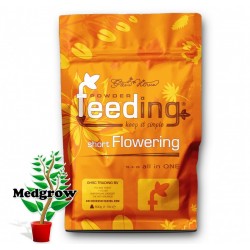
Green House Feeding Grow 50g is a mineral powder for the vegetative stage. NPK 21-5-10 with 2 % magnesium, made for mother plants and cuttings.
Green House Feeding Grow 50g is the vegetative formula of the maker's mineral line. It carries a lot of nitrogen and suits every plant in its leafy phase. The maker recommends it for mother plants and cuttings. It also works as a foliar feed, sprayed on the leaves. This fertiliser comes as a fine powder that dissolves in water, so the small pack is quick to work with. The figures below are taken from the maker's analysis.
Plants need more nitrogen in the vegetative stage than in flowering. Nitrogen drives photosynthesis and the building of proteins. For that reason, this formula holds 21 % total nitrogen. Of that, 7.9 % is nitrate and 13.1 % is ammoniacal nitrogen. Plants take up both forms directly. The maker writes that this rich nitrogen share gives a more robust, branched structure and thicker leaves.
Next to the nitrogen, the powder holds 5 % phosphate and 10 % potassium oxide. Magnesium oxide sits at 2 % and sulphur at 9.6 %. The trace elements are boron 0.02 %, copper 0.04 %, iron 0.1 %, manganese 0.05 %, molybdenum 0.01 % and zinc 0.01 %. Copper, iron, manganese and zinc are EDTA chelates. Every element is water-soluble, so this fertiliser leaves no residue in the tank.
The maximum solubility is 160 g per litre of water. For a concentrated solution, the maker advises 30 g per litre. In the vegetative stage, the line goes up to about 1.0 g per litre. Check EC and pH after mixing. Water at about 18 to 22 degrees helps the powder dissolve.
The same formula comes in the Grow 125 g pack. An organic option for the same stage is Bio Grow 500 g. When the plants start to flower, move on to Hybrids 50 g. The full line sits under Green House Feeding, and meters under garden accessories. Background reading: plant nutrition.
Can Green House Feeding Grow 50g be sprayed on leaves? Yes. The maker lists it as a foliar feed too.
What is the EC of one gram per litre? One gram per litre gives an EC of 1.4.
Green House Feeding Grow 50g is a mineral powder for the vegetative stage. NPK 21-5-10 with 2 % magnesium, made for mother plants and cuttings.